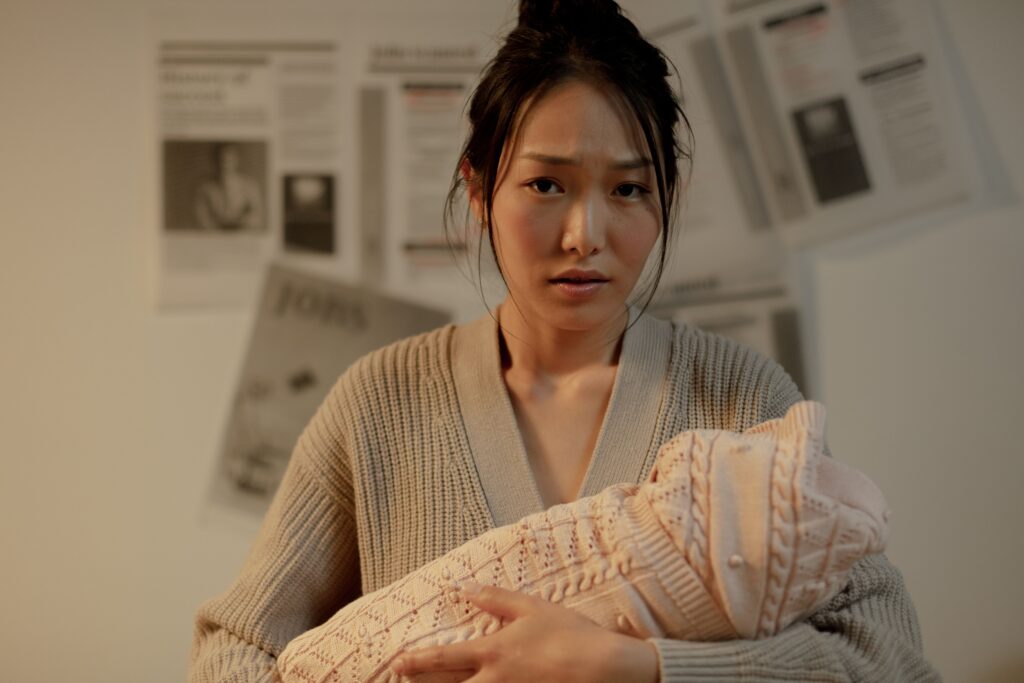
Nobody warns you about this part.
They warn you about the sleep deprivation. About the physical recovery. About how hard breastfeeding can be. But very few people tell you that somewhere in the fog of the first weeks and months of motherhood, you might look in the mirror and not quite recognize the person looking back. Not because something is wrong with you. Because something enormous has happened to you — and you have not yet had the time, space, or language to process what it means.
The loss of a previous sense of self in early motherhood is one of the most common and least acknowledged experiences of the postpartum period. It has a name. It is not pathological. And understanding it is the first step toward finding your footing on the other side of it.

Matrescence: The Identity Shift Has a Name
In 1973, medical anthropologist Dana Raphael coined the term matrescence to describe the developmental process of becoming a mother. The word is constructed deliberately to mirror adolescence — another period of profound biological, psychological, and social transformation that reshapes identity at its foundations.
Like adolescence, matrescence is not an event. It is a process. It unfolds over months and years, not days. And like adolescence, it involves a genuine reorganization of the self — not the addition of a new role onto an unchanged person, but a fundamental shift in how you experience yourself, your relationships, your priorities, and your place in the world.
The concept of matrescence was largely overlooked for decades after Raphael introduced it. It has re-entered mainstream conversation in recent years through the work of reproductive psychiatrist Dr. Alexandra Sacks and others who have argued that the identity transformation of becoming a mother deserves the same recognition and support that adolescence receives — and currently does not get.
Understanding matrescence does not resolve the disorientation of early motherhood. But it names it. And being named is the beginning of being understood.
What the Identity Shift Actually Feels Like
The experience of postpartum identity disruption is not uniform. It does not always look like sadness or crisis. Sometimes it is quieter than that — a low-grade sense of unfamiliarity, a feeling of being slightly outside yourself, a grief for a version of your life that no longer exists alongside a love for the one that does.
Common experiences include:
Ambivalence. Feeling profound love for your baby and simultaneous grief for your pre-baby life — in the same moment, without contradiction. Many mothers find this ambivalence alarming, as though the grief cancels out the love or reveals something wrong with their feelings. It does not. Ambivalence is a normal feature of any significant transition, and it is particularly pronounced in one as total as becoming a parent.
Loss of the previous self. The person you were before — with her particular rhythms, freedoms, relationships, and sense of identity — has changed. Some of what she was is gone, at least in its previous form. Grieving that loss is not ingratitude for what you have gained. It is an honest response to genuine change.
Uncertainty about who you are now. The previous markers of identity — your work, your social life, your body, your relationships, your daily routines — have all shifted simultaneously. In the absence of those familiar anchors, many women feel unmoored. Not depressed, necessarily. Just not yet sure where they stand.
Disconnection from your pre-baby self. Some women describe feeling like their pre-baby life happened to someone else — a strange temporal dislocation where the person they were feels both very recent and very distant at the same time.
Invisibility. The social experience of new motherhood can involve a particular kind of erasure — being seen primarily as a mother and caregiver rather than as a full person with her own interiority, professional identity, and needs. This invisibility is compounding when it comes from people who knew you before.
A surprising sense of competence. Identity shift is not uniformly painful. Many women also describe discovering capacities they did not know they had — a groundedness, a protectiveness, a clarity about what matters — that feels like a genuine expansion of self rather than purely a loss.
The Neurological Basis of Identity Change
Matrescence is not just a psychological experience. It is a neurological one.
Research published in Nature Neuroscience found that pregnancy produces measurable, lasting changes in the structure of the maternal brain — specifically in regions associated with social cognition, empathy, and the ability to read and respond to another person’s mental and emotional states. These changes persist for at least two years after birth and are associated with stronger maternal attachment.
Your brain is literally reorganizing itself around the task of knowing and caring for your baby. The version of you that exists after becoming a mother is neurologically different from the version that existed before — not diminished, but genuinely changed in structure and function.
This is significant not because it explains everything but because it validates the felt experience of being different. You are not imagining it. You are not being dramatic. Something real has happened to your brain, your body, and your self — and the disorientation of early motherhood is in part the experience of becoming someone new before you have had the chance to meet her.
The Relationship With Your Body
The postpartum body is one of the most fraught aspects of the identity shift — and one of the least honestly discussed.
Your body has done something extraordinary. It grew and delivered a human being. It is now sustaining that human being through feeding. It is simultaneously healing from the physical demands of pregnancy and birth while operating on fragmented sleep and significant nutritional demands.
It also looks and feels different. The shape has changed. The texture has changed. Things that used to be familiar — the fit of clothing, the way you move, the reflection in the mirror — are unfamiliar in ways that can be disorienting even when you know intellectually that your body has earned every change.
The cultural pressure on postpartum bodies is relentless and worth naming directly: the expectation of rapid return to a pre-pregnancy shape is not a health standard. It is a commercial one, sustained by industries that profit from maternal body dissatisfaction. Your body is not a problem to be solved. It is the body that did the work. It deserves time, nourishment, and a standard of care that prioritizes recovery over aesthetics.
Being at peace with your postpartum body is not about loving every change. It is about refusing to measure its worth by a standard that was never designed with your actual wellbeing in mind.
Our Postpartum Recovery Essentials guide covers what your body actually needs in the physical recovery period — because tending to your body is part of tending to yourself.
The Relationship With Your Work Identity
For women whose professional identity was a significant part of how they understood themselves before becoming a mother, the postpartum period can involve a particular kind of disorientation.
On maternity leave, the professional self is suspended. The structures — meetings, projects, expertise, colleagues, the daily rhythm of work — that provided identity scaffolding are absent. What remains is motherhood, in all its intensity and isolation. For some women this feels like relief. For others it feels like losing a significant part of who they are, with nothing yet to replace it.
The return to work, when it comes, brings its own identity complexity — the collision of the professional self and the maternal self in a culture that has not yet figured out how to hold both without asking women to sacrifice one for the other.
There is no clean resolution to this. What helps is naming it — acknowledging that the professional identity is real and worth honouring, that ambivalence about the transition back to work is normal and not a reflection of how much you love your baby, and that the integration of the professional and maternal self is a process that takes longer than most people expect.
The Relationship With Your Partner
Becoming parents together changes a relationship. This is not a sign that something is wrong with the relationship. It is an inevitable feature of a profound shared transition.
The specific changes vary — but common shifts include:
- A reorganization of intimacy, as physical and emotional energy is directed toward the baby during an exhausting period
- Unequal distribution of the mental and physical load of new parenthood, which can generate resentment even in relationships with strong foundations
- A temporary narrowing of shared life to the logistics of infant care, which can make partners feel more like co-managers than romantic partners
- Different paces of adjustment to the identity shift of parenthood
The relationship before the baby existed is not gone. But it requires intentional tending in this period — not grand gestures, but small, consistent ones. Named appreciation. Explicit communication about what you need. The understanding that this is a temporary phase of intensity rather than the permanent shape of the relationship.
Our Mental Load of New Motherhood guide addresses the invisible labour that lands disproportionately on mothers and what redistribution actually looks like in practice.
The Relationship With Your Friends
Friendships shift after a baby. Some deepen. Some fade. Some reveal themselves to be less resilient than you assumed. And new ones form — often with people you barely knew before who are now navigating the same terrain.
The friendships that fade are not necessarily failures of those relationships. They are sometimes simply the honest recognition that shared circumstance was doing more work than shared values — and that a major life change surfaces that distinction.
The friendships that deepen are often ones grounded in something more durable than convenience. Tending to these — imperfectly, with the limited bandwidth of early parenthood — is worth the effort.
Finding community with other new mothers — in person or online — can provide a particular kind of sustenance that established friendships sometimes cannot. The specific, granular knowledge of what this particular season of life is like is something only people living it can offer. That shared understanding is not a small thing.
When Identity Disruption Becomes Something More
Matrescence is a normal developmental process. It is not pathological, and it does not require clinical treatment.
But the territory of postpartum identity disruption overlaps with the territory of postpartum mental health conditions — and the distinction matters.
Postpartum depression is not just sadness. It can present as numbness, disconnection, irritability, inability to feel pleasure, persistent hopelessness, or difficulty bonding with the baby. It is common — affecting approximately one in five new mothers in Canada — and it is treatable.
Postpartum anxiety often presents as relentless worry, intrusive thoughts, hypervigilance about the baby’s safety, and an inability to rest even when the opportunity exists. It is at least as common as postpartum depression and significantly underdiagnosed.
Postpartum OCD involves intrusive, unwanted thoughts — often about harm coming to the baby — that are distressing and inconsistent with the mother’s values and intentions. These thoughts are a symptom of OCD, not an indication of danger.
If the identity disruption you are experiencing is accompanied by persistent low mood, inability to function, disconnection from your baby, or thoughts of harming yourself or others — these are symptoms that warrant professional support. They are not weakness. They are medical conditions with effective treatments.
The Society of Obstetricians and Gynaecologists of Canada recommends routine postpartum mental health screening at the six-week visit and beyond. If your care provider has not asked about your emotional wellbeing, raise it yourself. You do not have to reach a crisis point to deserve support.
Postpartum Support International maintains a Canadian resource directory and helpline at 1-800-944-4773 and at postpartum.net.
Who You Are Becoming
The disorientation of early matrescence is not permanent. The women who have been through it — who have moved through the fog of the first year and come out the other side — often describe not a return to who they were before, but an arrival at someone new.
Someone who knows things about themselves that she did not know before. Who has discovered capacities she did not know she had. Whose priorities have clarified in ways that feel true rather than imposed. Who carries both her previous self and her maternal self — not as a contradiction but as an expansion.
This is not guaranteed. It does not happen automatically, or on any particular timeline. And it is complicated by the structural failures of the societies most new mothers live in — the inadequate parental leave, the lack of childcare, the mental load, the expectation of graceful functioning in conditions that are genuinely very hard.
But it is available. And the path toward it runs through the same territory as everything else in this period — honesty about what is actually happening, community with people who understand it, and the willingness to extend to yourself some fraction of the care you are extending so generously to everyone else.
You are not who you were before. You are not yet fully who you are becoming. The space between those two things is uncomfortable and temporary and real — and you are not alone in it.
→ Read our Mental Load of New Motherhood guide — the invisible labour of new parenthood and how to redistribute it.
→ Read our Postpartum Recovery Essentials guide — what your body actually needs in the first weeks and months after birth.
→ Read our Gifts That Actually Help After Birth guide — practical support ideas for the people around a new mother.
→ Shop the Cradle Song Co collection — curated essentials for pregnancy, postpartum, and baby’s first year.