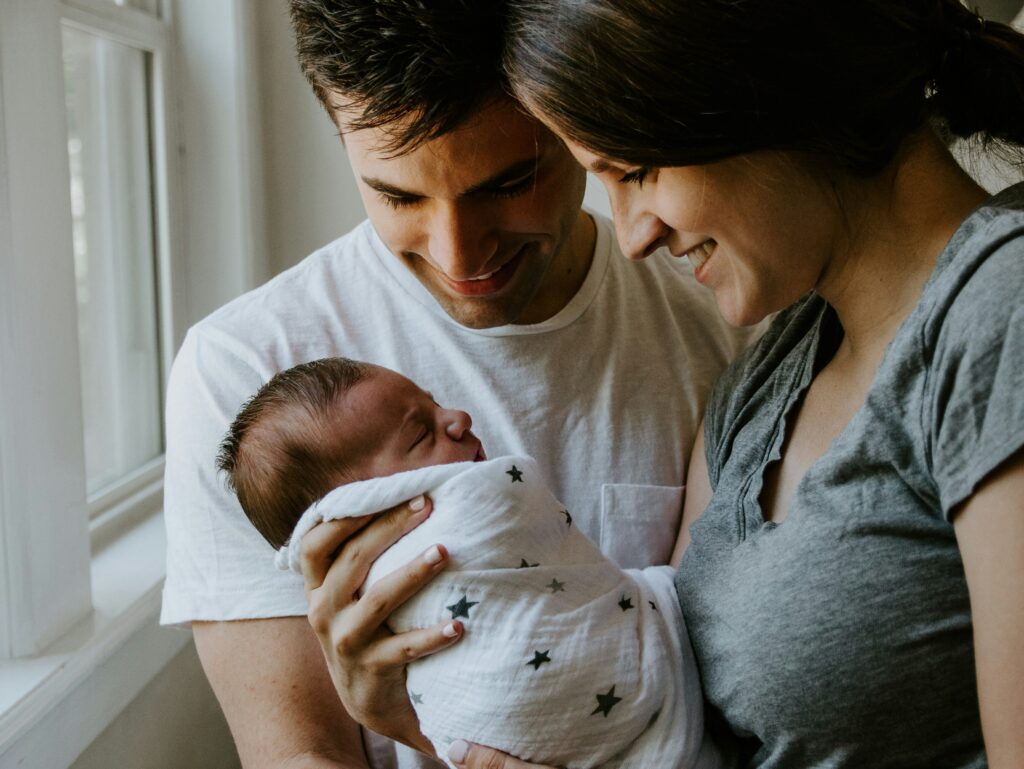
If you have spent any time searching “signs of a highly intelligent baby,” you are not alone — and you are probably not searching because you are worried. You are searching because you noticed something. Your baby tracked your face earlier than you expected. They responded to your voice in a way that felt deliberate. They seem, somehow, more alert than you anticipated.
This guide gives you the honest, science-backed answer to what those observations actually mean — and what developmental milestones can and cannot tell you about your baby’s intelligence.
What “Intelligence” Actually Means in Infancy
Before getting into signs, it is worth being honest about the word itself.
Intelligence in adults is complex, multidimensional, and still debated among researchers. In infants, it is even harder to define — because a baby’s brain is not a smaller version of an adult brain. It is a fundamentally different organ at a fundamentally different stage of construction.
What we can observe in infancy is development — the rate and sequence at which a baby acquires skills across four broad domains:
- Cognitive — thinking, problem-solving, understanding cause and effect
- Language — receptive (understanding) and expressive (communicating)
- Motor — gross motor (large movements) and fine motor (small, precise movements)
- Social and emotional — bonding, reading cues, responding to others
A baby who develops quickly across these domains is developing well. Whether that translates into what we’d call “intelligence” later in life is genuinely difficult to predict — and most developmental pediatricians will tell you so.
The Canadian Paediatric Society emphasizes that a wide range of developmental timelines is normal and healthy. Early achievement of milestones is encouraging. It is not, on its own, a reliable predictor of long-term cognitive ability.
That said — here is what to watch for.
Signs of Strong Early Development
1. Extended Eye Contact and Face Tracking
Newborns are born with blurry vision — they can focus clearly at roughly 20 to 30 centimetres, which is almost exactly the distance between a feeding baby’s face and their parent’s face. Not a coincidence.
Within the first few weeks, babies begin tracking moving faces with their eyes. By six to eight weeks, most babies make deliberate, sustained eye contact. A baby who does this early and holds it for longer-than-average stretches is demonstrating strong early social and cognitive engagement.
Eye contact is not just bonding behaviour. It is information processing — your baby is studying your face, reading your expressions, and beginning to build a model of human communication.
2. Early Responsiveness to Voice and Sound
Babies respond to their mother’s voice from birth — they have been hearing it in the womb since roughly 18 weeks of gestation. What varies is how quickly and specifically they respond to voices after birth.
A baby who turns toward familiar voices early, who quiets at the sound of a specific person, or who appears to distinguish between voices — rather than simply reacting to loud sounds — is showing early auditory processing sophistication.
By two to three months, babies who are developing well begin making deliberate sounds in response to being spoken to. This proto-conversation — where they vocalize, pause, and wait for a response — is one of the earliest signs of language development.
3. Curiosity and Visual Exploration
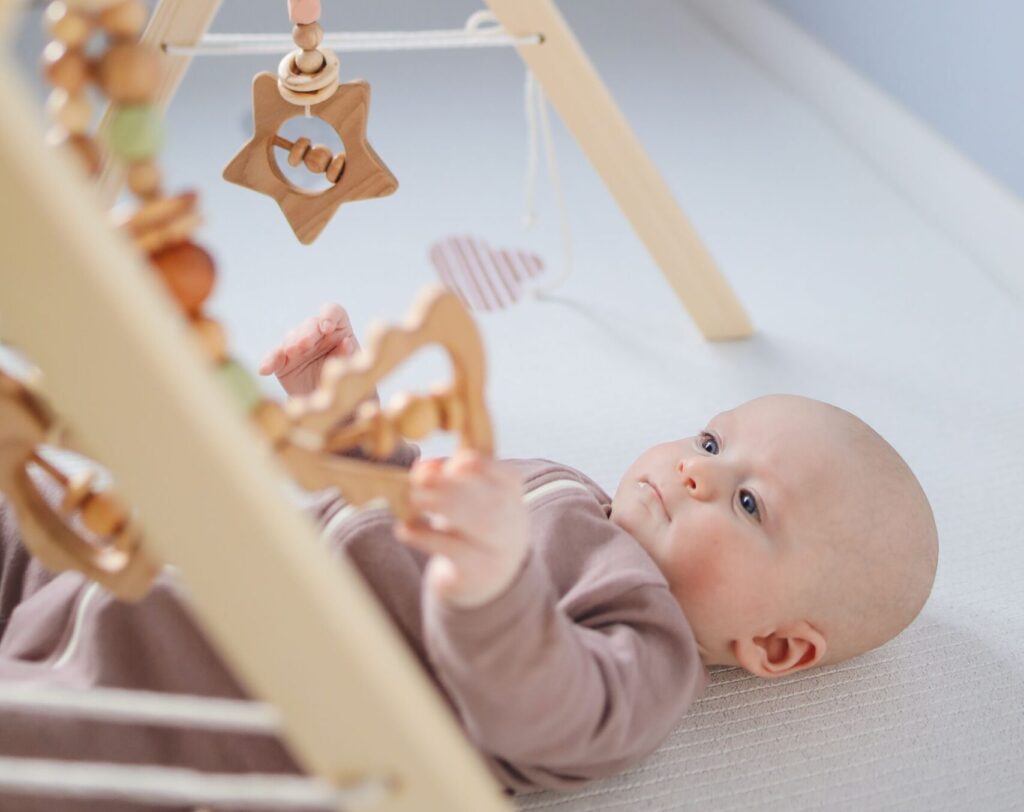
Some babies seem content to lie quietly and observe. Others appear almost restless in their need to take in new information — turning toward movement, studying objects, appearing frustrated when the view doesn’t change.
High curiosity in infancy — the consistent drive to look at, reach toward, and engage with new stimuli — is one of the more reliable early indicators researchers associate with strong cognitive development. It reflects what developmental psychologists call habituation and dishabituation: the ability to recognize something familiar and show heightened interest in something new.
A baby who quickly loses interest in a repeated stimulus and lights up at something novel is demonstrating exactly this.
4. Early Social Smiling
The first smile that is genuinely social — directed at a person rather than caused by gas or a reflex — typically appears between six and twelve weeks. A baby who produces social smiles at the earlier end of that window, and who uses them responsively in back-and-forth interaction, is showing strong social-emotional development.
Social smiling requires your baby to recognize a face, associate it with positive experience, and produce a coordinated facial expression in response. It is a cognitively complex behaviour dressed up as something simple and delightful.
5. Reaching Developmental Milestones Consistently Early
The Public Health Agency of Canada’s postpartum and infant health guide provides milestone ranges for each stage — not single points, but windows.
Key milestones to track in the first year:
- 2 months: Social smile, tracks objects, coos
- 4 months: Laughs, reaches for objects, holds head steady
- 6 months: Responds to name, transfers objects hand to hand, sits with support
- 9 months: Object permanence (looks for hidden objects), babbles with consonants, pulls to stand
- 12 months: First words, points to objects, imitates actions
A baby who reaches these consistently early is developing well. A baby who reaches them within the normal window is also developing well. Both are worth celebrating.
6. Strong Object Permanence
Object permanence — the understanding that an object continues to exist even when it cannot be seen — typically develops between four and eight months. You can observe it informally: hide a toy under a blanket in front of your baby. Do they look for it, or do they act as though it has ceased to exist?
A baby who searches for hidden objects on the earlier end of the developmental window is demonstrating early abstract thinking — the cognitive ability to hold a mental representation of something that is not immediately visible. This is a significant milestone in cognitive development.
7. Imitation and Intentional Communication
By nine to twelve months, babies who are developing strongly begin to imitate actions deliberately — waving, clapping, pointing — and use those actions to communicate. A baby who points to something they want, makes eye contact with you, and then looks back at the object is performing a behaviour called joint attention — and it is one of the most significant early predictors of language and cognitive development researchers have identified.
Joint attention requires your baby to understand that you have a perspective, that you can follow their gaze, and that communication is a two-way process. It is cognitively sophisticated, and babies who demonstrate it clearly and early are showing strong developmental foundations.
What Milestones Cannot Tell You
Milestones measure the sequence and approximate timing of skill acquisition. They are genuinely useful. They are not a complete picture.
Some things milestones do not predict reliably:
- Creativity and divergent thinking
- Emotional intelligence and resilience
- Long-term academic performance
- Specific talents or areas of exceptional ability
The baby who walks at nine months does not necessarily become a better athlete than the baby who walks at fifteen months. The baby who speaks early does not necessarily become a more articulate adult. Development is not a race, and early achievement in one domain does not guarantee outcomes in others.
What milestones do tell you is that your baby’s brain and body are developing. That their environment is supporting that development. And that the investment you are making in responding to them, talking to them, and engaging with their curiosity is working exactly as it should.
How to Support Your Baby’s Development
The single most evidence-supported thing you can do for your baby’s cognitive development is also the simplest: respond to them. Talk to them constantly, narrate what you are doing, make eye contact, follow their gaze, and treat their early attempts at communication as real communication — because they are.
Beyond that, an environment that is safe, stimulating, and free of unnecessary chemical exposures gives your baby the physical foundation their developing brain needs. That includes the products you use on their skin, in their mouth, and in their sleep environment.
If you are building out your baby’s essentials with development in mind, our Newborn Essentials guide covers the first three months stage by stage. And if you are still putting together your registry, our Baby Registry Checklist cuts through the noise on what is actually worth having.
→ Read our Newborn Essentials guide — everything you need for the first three months, by stage.
→ Read our Baby Registry Checklist — the honest guide to what’s worth registering for.
→ Shop the full Cradle Song Co collection — every product verified for Canadian safety standards.